From Military to Firefighter in California
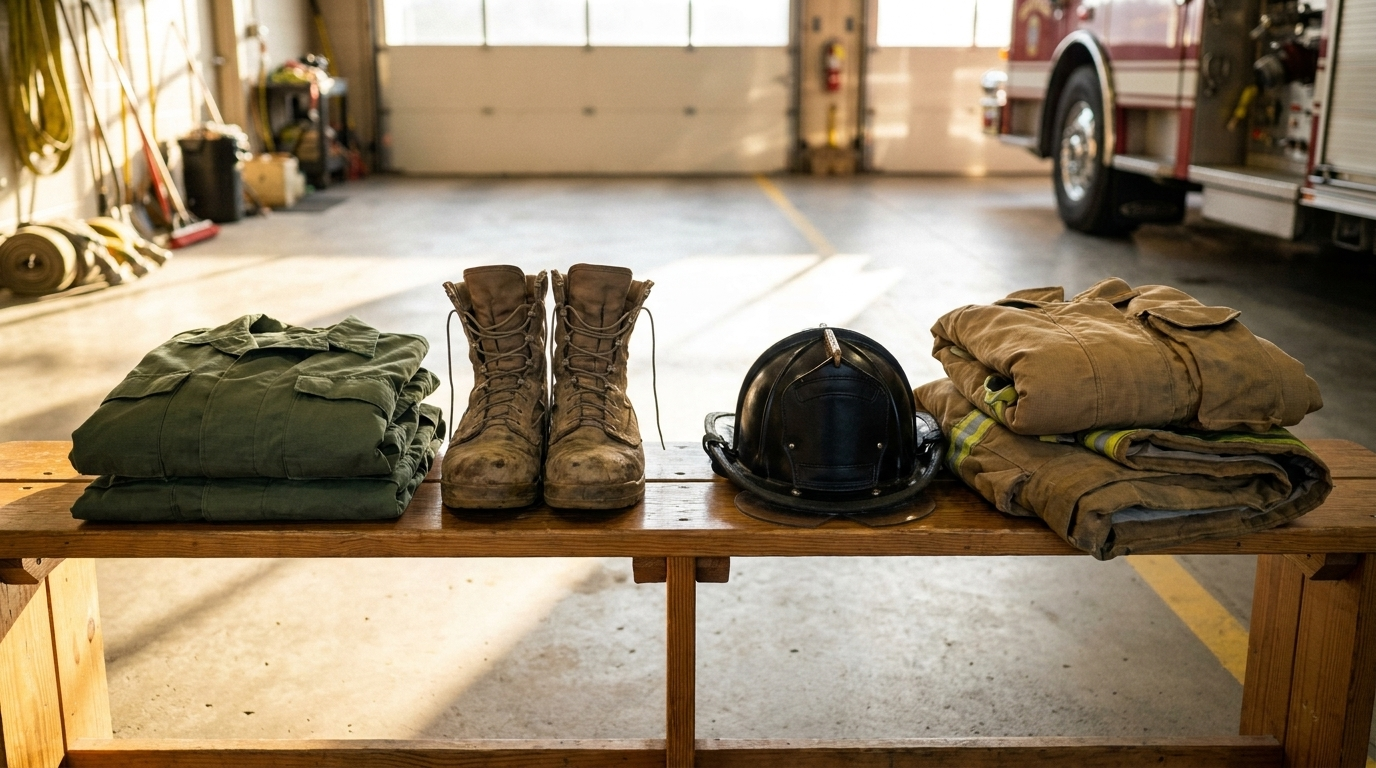
If you served, you already practice a lot of what the fire service looks for. You show up early. You take orders and give them. You have carried weight when you were tired and scared and did it anyway. Some California departments recruit veterans on purpose, and the state runs a formal hiring preference for its own civil service lists. That can be a real advantage, and you should use every piece of it.
It is also not a shortcut. Approved veterans' preference can place you in the top rank on California state civil-service lists, while city and county rules vary. Military service does not waive a department's certifications, physical test, written test, interview, or background requirements. This guide covers both sides: the doors your service opens, and the work still in front of you.
The Advantages Your Service Actually Gives You
Start with what is real, because it is worth a lot.
Veterans' preference on civil service lists. California rewards service on state hiring lists, and it does it through ranking, not bonus points. If the California Department of Human Resources approves your Veterans' Preference application and you pass the entrance exam, you are placed in the top rank of the eligibility list (CalCareers Veterans' Preference). On lists that hire from the top ranks only, that placement is a serious edge. Three things to know up front. It applies to open examinations, meaning first entry into state civil service rather than promotions later, and it stops being applied once you gain permanent civil service status. Discharge characterization matters: CalHR states that a veteran who has been dishonorably discharged or released is not eligible. If your discharge is anything other than honorable, confirm your own eligibility with CalHR rather than assuming. And that page covers state civil service only. City, county, and district fire departments set their own rules, and some run a veterans' preference in their charter or local civil service rules while others do not. Confirm the exact rule with each department before you count on it.
Departments that recruit veterans on purpose. CAL FIRE runs a program built for this transition called RVETS, Returning Veterans; Enlisting Their Skills for CAL FIRE Service. Working with CalVet and the California National Guard, it helps veterans, reservists, National Guard members, and their families explore employment and education paths into the department (CAL FIRE RVETS). Some municipal departments make a similar effort without a named program. When you find one, lean in.
Your experience translates. Leadership under pressure, working inside a chain of command, physical discipline, attention to detail on a checklist, and calm when things go sideways are the exact habits that get you through an academy and a probationary year. If you held an EMS or medic role, a hazmat or CBRN specialty, firefighting or crash rescue, logistics, or heavy equipment, you are carrying skills that map straight onto the job. The trick is knowing how to prove them on paper and in the room, which we cover below.
The Work Your Service Does Not Skip
Now the part that does not bend. California sets the same baseline for everyone, and a DD-214 does not change it.
You will almost certainly need your EMT certification. California departments run mostly medical calls, and most require an EMT at some point in the process, though it is not a statewide rule. It is not required for placement on the FCTC Statewide Eligibility List, for example, but many departments list it as a minimum qualification on their own bulletins. If you were a medic or corpsman, your military training does not automatically convert to a California EMT card, though it can shorten your road (more on that below). Whether the requirement lands before you apply or after you are hired varies by department, so read Do You Need Your EMT Before Applying? and confirm with each agency.
You may need Firefighter I training or a fire academy before applying, but this is not universal. Some departments require a self-sponsored academy or Firefighter I; others hire entry-level recruits and put them through a paid department academy. See Fire Academy vs. Fire Technology in California, then follow each current job bulletin.
You still have to pass the physical test your target department requires. Many use the CPAT, while others use Biddle, BPAT, VCPAT, or a department-specific test. Military fitness helps, but these tests measure specific work, so train for the actual events. Read How to Pass the CPAT if CPAT is your route.
You still take the written test and follow the eligibility process your target department uses. For FCTC departments, a passing written score is one SEL requirement alongside a valid CPAT, complete profile, current documents, and other minimum qualifications; departments then rank candidates in their own processes. Other agencies use NTN, CalCareers, or their own tests. You still clear the department's interview, background, medical, and any psychological steps it requires.
Hold both facts at once. You start ahead. You still have to run the whole race.
Using the GI Bill for EMT, the Academy, and Beyond
This is where a lot of veterans leave money on the table. Your education benefits can cover most of the training on this path.
EMT and the academy. The Post-9/11 GI Bill (Chapter 33) pays full in-state tuition and fees at public schools if you qualify for the maximum benefit, plus a housing allowance and a books stipend (VA Post-9/11 GI Bill). It also covers approved non-college-degree programs, and the VA names emergency medical technician training as one of its own examples (VA Non-College Degree Programs). At private and for-profit schools those programs are paid up to an annual cap, so check the current figure on the VA rate tables before you commit. Community college EMT courses, fire academies, and fire technology programs at approved California schools are commonly eligible, but eligibility is program by program, not category-wide. Confirm a specific program's approval with the school's certifying official and the VA before you enroll.
Apprenticeship and on-the-job training. California runs a firefighter apprenticeship through the California Firefighter Joint Apprenticeship Committee (Cal-JAC), and it is set up for GI Bill use. Veterans in a participating department, with a signed apprentice agreement, can draw benefits under the Montgomery GI Bill (Chapter 30), the Post-9/11 GI Bill (Chapter 33), or the Montgomery GI Bill Selected Reserve (Chapter 1606) (Cal-JAC Veterans' Benefits). The general rule is that you separated within the last 10 years or are an active reservist, and each month you certify your training and pay to the VA. On-the-job training and apprenticeship benefits pay a monthly amount for living expenses while you earn a paycheck and learn the job (VA On-the-Job Training and Apprenticeships). Under the Post-9/11 GI Bill that payment steps down as you go: the VA pays 100 percent of the applicable housing rate for the first six months, then 80, 60, and 40 percent in each following six-month block, and 20 percent after two years (VA Post-9/11 GI Bill rates). The catch is that the benefit only exists if your department participates, so ask before you assume.
One correction on VET TEC. You may hear VET TEC mentioned for career training. VET TEC 2.0 covers high-tech fields only, computer programming, software, data processing, information sciences, and media (VA VET TEC 2.0). It does not cover fire, EMT, or the trades. For this path, your vehicle is the standard GI Bill and the apprenticeship, not VET TEC.
A word on burning benefits. Your GI Bill has a limit. Spending it on EMT and a fire academy is a strong use if it lands you the career. Just go in with eyes open, and talk to a VA education counselor or a school certifying official about how much you will use and what you want to keep in reserve.
SkillBridge: Start the Transition Before You Separate
If you are still serving, SkillBridge can provide up to 180 days of permissive duty during your final stretch of service for approved civilian training, apprenticeship, or internship experience. You continue to receive military compensation and benefits during it, and the industry partner provides the training. Participation requires approval from your unit commander and an authorized provider, and approval is not automatic. The Department does not financially support partner programs, so terms vary by provider; do not assume an employer covers every training expense. Check the current official SkillBridge overview and your service branch before making plans.
How to Frame Military Experience in the PHS and Oral Board
This is the part veterans most often get wrong, and it is the most fixable. Your service is an asset only if the reader and the panel can see how it fits firefighting. Do the translation for them.
On the Personal History Statement. The PHS is a long, detailed background document, and it is not the place to be vague or to assume the reader knows military structure. Spell out ranks, roles, and dates in plain terms a civilian investigator understands. Be precise and be honest, because the background investigation will verify what you write, and inconsistencies end candidacies faster than the underlying facts usually would. Our full walkthrough is The Personal History Statement, Explained, and the investigation itself is covered in The Firefighter Background Investigation.
On the oral board. Translate every skill into a fire-service outcome. Do not say you led a squad. Say you were responsible for the readiness, discipline, and safety of a team, and give a short example of a time it mattered. Tie your medic experience to patient care and staying calm on a bad call. Tie logistics to accountability and getting the right resources to the right place. Tie hazmat or CBRN training to the discipline of working a scene by the book. The panel is listening for someone who works inside a team and a chain of command, follows procedure, and stays level when it counts. That is your language already. Use short, true stories, and practice them out loud. Prepare with Firefighter Oral Board Questions and How to Stand Out and Get Hired.
One caution. Do not lead with rank or lean on service as if it entitles you to the job. Panels notice that fast, and it reads the wrong way. Let the work speak. Humility plus a clear record beats a chest full of credentials every time.
A Realistic Order of Operations for Veterans
Here is a sensible sequence. You will often work several of these at once.
- If you are still in, look into SkillBridge and get your DD-214 and service records in order.
- File your Veterans' Preference application with CalHR for state civil service lists, and ask each city, county, and district department whether it has a veterans' preference of its own.
- Use the GI Bill for an approved EMT, academy, or fire technology program that fits your target departments.
- Train for and pass the physical test each target department requires.
- Take the appropriate written test and keep every FCTC SEL or department-list requirement current.
- Apply widely. Look hard at CAL FIRE RVETS and at any department with a veteran-focused apprenticeship.
- Prepare your PHS and oral board with the translation work above.
- Clear the background, medical, and psychological steps, then the department academy and probation.
If wildland is where your outdoor experience points you, CAL FIRE and the federal agencies are a strong fit. Read The Wildland Firefighter Career in California.
FAQ
Does military service guarantee me a firefighter job in California?
No. It can provide a real edge through state veterans' preference and departments that actively recruit veterans, but local preference rules vary. You still complete every certification, physical test, written test, interview, and background step the target department requires. Service does not skip the requirements.
Do veterans get extra points on California firefighter tests?
On state civil service lists, California uses top-rank placement rather than bonus points. Once CalHR approves your Veterans' Preference and you pass an open exam, you are placed in the top rank of the resulting eligibility list, which is a strong advantage. That rule covers state civil service only. City, county, and district departments set their own rules, and some have no veterans' preference at all, so confirm the exact method with each department.
Can I use the GI Bill to pay for EMT and the fire academy?
Usually, yes, at VA-approved schools. The Post-9/11 GI Bill covers approved non-college programs like EMT, and community college fire academies and fire technology programs are commonly eligible. Confirm a specific program's approval with the school's certifying official and the VA before enrolling.
Does my military medic or corpsman training count as a California EMT?
Not automatically. California EMT certification runs through a state-approved training program and the National Registry cognitive and psychomotor exams, after which a local EMS agency or other certifying entity issues the certification (EMSA). Military medical training can shorten the road, and some programs give veterans credit toward it, but you still need the California certification. Check with the EMS program and the local EMS agency for your county, and read Do You Need Your EMT Before Applying?
What is CAL FIRE RVETS?
RVETS stands for Returning Veterans; Enlisting Their Skills for CAL FIRE Service. It is CAL FIRE's program, run in partnership with CalVet and the California National Guard, to help veterans, reservists, National Guard members, and their families explore employment and education options across the department's many civil service classifications. Details and current contacts are on the CAL FIRE RVETS page.
How do I talk about my service on the oral board without overdoing it?
Translate skills into fire-service outcomes and use short, true stories. Tie leadership to team readiness and safety, medic work to patient care and staying calm, logistics to accountability. Do not lead with rank or act as if service entitles you to the job. Let the record speak, and prepare with Firefighter Oral Board Questions.
Start With One Step
You already know how to attack a mission with a plan and finish it. Point that at this. For most veterans the first move is filing the Veterans' Preference application and getting the GI Bill working on the EMT. Pick that step and start it this week. The full path is laid out in How to Become a Firefighter in California.
Sources
- Veterans' Preference - California Department of Human Resources / CalCareers (top-rank placement on state civil service lists, open exams only, stops at permanent status, dishonorable discharge not eligible)
- CAL FIRE RVETS - CAL FIRE (Returning Veterans; Enlisting Their Skills for CAL FIRE Service program)
- Cal-JAC Veterans' Benefits - California Firefighter Joint Apprenticeship Committee (GI Bill use in the firefighter apprenticeship, Chapters 30, 33, 1606; 10-year separation rule; monthly certification)
- Post-9/11 GI Bill (Chapter 33) - U.S. Department of Veterans Affairs (tuition, housing, and books benefits)
- Non-College Degree Programs - U.S. Department of Veterans Affairs (EMT training named as a covered non-college-degree program)
- Post-9/11 GI Bill rates - U.S. Department of Veterans Affairs (annual non-college-degree cap; apprenticeship housing allowance step-down of 100/80/60/40/20 percent)
- On-the-Job Training and Apprenticeships - U.S. Department of Veterans Affairs (who qualifies and what the benefit pays)
- VET TEC 2.0 - U.S. Department of Veterans Affairs (high-tech fields only; does not cover fire or EMT)
- EMT certification - California Emergency Medical Services Authority (approved course, National Registry exams, certification by a local EMS agency or certifying entity)
- Official SkillBridge overview - up to 180 days of permissive duty, unit commander approval, authorized-provider model, and the caveat that partner programs are not financially supported by the Department
Golden State Firefighter is an independent resource and is not affiliated with CAL FIRE, the FCTC, Cal-JAC, the U.S. Department of Veterans Affairs, the Department of Defense, or any fire department. Veterans' benefits, program approvals, and department rules change and vary, so always verify details with the department, the VA, and official sources before you rely on them. No outcome is guaranteed.