Fire Station Etiquette: The Rookie's Unwritten Rules
The skills you can learn from a manual. The station is a different classroom. Fire station etiquette is the set of unwritten rules that decide whether the crew is glad you walked in the door. On probation, that matters as much as anything you do on a call.
You are moving into a house with people who did not choose you, for 24 or 48 hours at a stretch. Here is how to fit in without stepping on anyone. Get this right and half of probation takes care of itself.
Why station life is part of the evaluation
A fire crew lives together. You share a kitchen, a dorm, a bathroom, and long hours of downtime between calls. How you behave in that house is not separate from the job. It is part of what your department is evaluating, and being hard to live with is a genuine wash-out reason, not a minor one. For the bigger picture, see surviving firefighter probation.
The good news: none of this requires talent. It requires humility, effort, and paying attention.
Show up right
Early is on time. On time is late. Get to the station with enough margin to relieve the off-going crew, check your assigned gear and apparatus, and be ready before the shift officially starts. Never make the person you are relieving wait.
Relieve the off-going crew promptly. They have been there a full shift. Do not stroll in at the last second and make them stay longer.
Introduce yourself. Firm handshake, look people in the eye, learn names fast. Use ranks and names correctly. You are the new person. Make the first move.
Own the chores
This is the clearest signal a probie sends. As the newest person, you do more than your share of the housework, and you do it without being asked.
- Be the first one up in the morning and get the coffee going.
- Take on the dishes, the mopping, the trash, the bathrooms, the apparatus bay.
- When you finish one thing, find the next thing. Do not sit while others work.
- Keep the common areas clean throughout the shift, not just at cleanup time.
Doing chores well buys you patience while your skills are still developing. Skipping them, or doing them only when told, is one of the fastest ways to sour a crew on you.
The kitchen
The kitchen is the heart of the firehouse and it has its own rules. They vary by house, so watch and ask, but the common ones hold almost everywhere.
- Learn how the crew handles meals. Many houses run a shared meal with a kitty everyone pays into. Pay your share promptly and never make someone chase you for money.
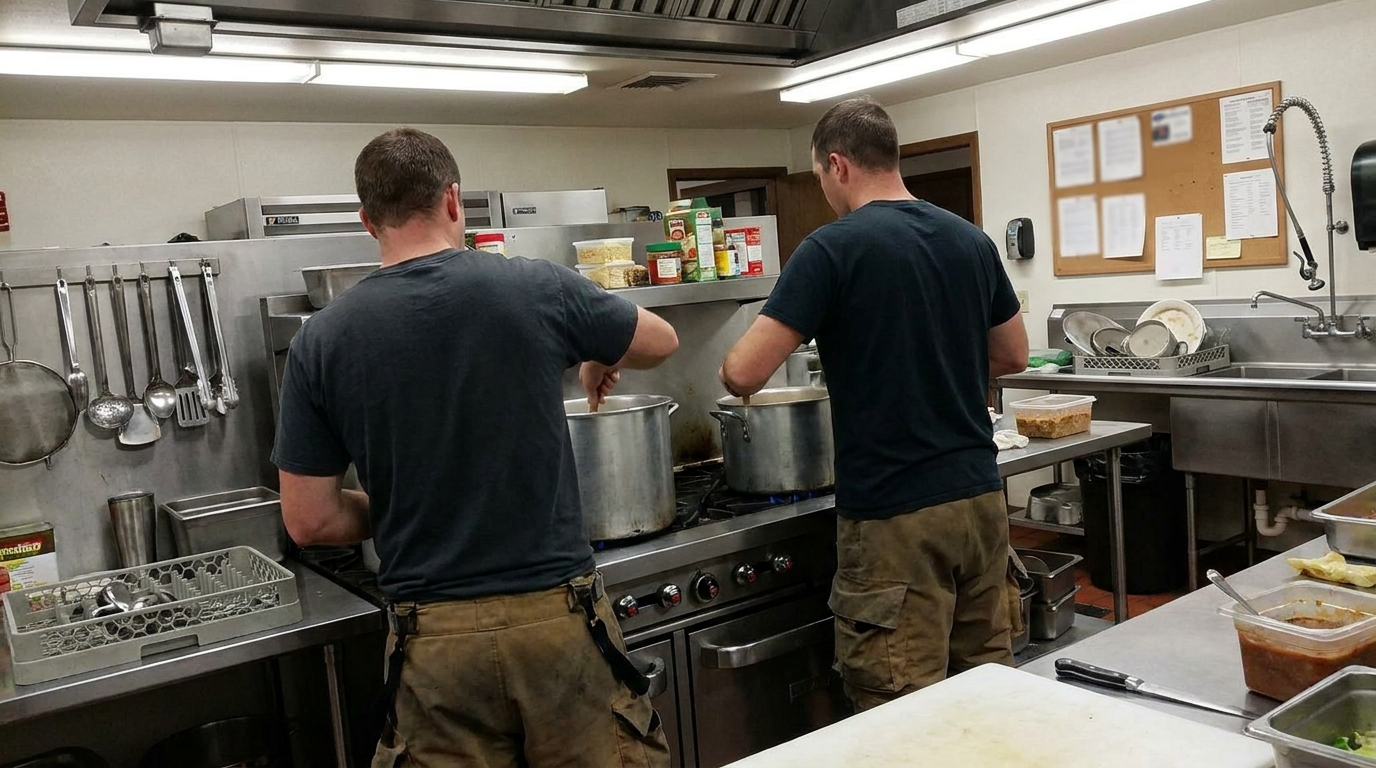
- As the probie, you help. Prep, cook if you can, and clean up after. Do the dishes. Wipe the counters. Take out the trash.
- Do not eat first. Let the senior members and the on-duty officer go ahead. Serve, then eat.
- If you can cook, it is a real asset. A probie who can put out a solid meal earns goodwill fast. If you cannot, learn a couple of dependable meals before you need them.
- Clean as you go and clean after. A trashed kitchen after your meal is a bad look every time.
Respect and listening
Talk less, listen more, especially early. Watch how the crew and your captain do things, then do it that way. You are learning the house, not reforming it.
Do not one-up the veterans. Whatever story someone tells, you do not have a better one. You have not earned it yet. Let them talk.
Ask questions at the right time. Not during a call, not when the officer is busy, not in the middle of a task. Save them for downtime and make them good questions that show you were paying attention.
Respect rank and seniority without being a bootlicker. Be genuine, be useful, and let the relationships build naturally over the shifts.
Keep the gossip and the complaining out of it. A crew is a small world. Negativity and drama travel fast and stick to whoever started them.
Downtime
Between calls there is downtime, and how you use it says a lot.
- Stay useful. When the veterans are training, cleaning, or working on the rig, you are too. Do not disappear to your phone while others work.
- Phone use has limits. Read the room. Endless scrolling while the crew is engaged reads as checked out. Follow your department policy and your crew's norms.
- Join in, within reason. Firehouse life includes shared meals, TV, and downtime together. Be part of it. Isolating yourself all shift reads as poor fit too.
- Keep training. Downtime is a chance to drill knots, review the task book, or study the district. Nobody minds a probie who is quietly getting better.
The dorm and shared space
- Respect sleep. People are trying to rest between calls, sometimes at odd hours. Be quiet in the dorm. No loud phones, no slamming doors.
- Keep your area squared away. Bunk made, gear stowed, your space clean.
- Mind your hygiene. You are living in close quarters. Shower, keep your uniform clean, and do not be the person others avoid.
- Do not touch what is not yours. Other people's gear, food, and space are off limits unless you are told otherwise.
When the tones drop
- Be ready before you need to be. Your gear is checked and staged so you are not the reason the rig is slow.
- Follow, do not freelance. On a call you do your job and follow direction. Probation is not the time to improvise.
- Debrief with humility. After the call, listen to the critique. Take the correction. See why probationary firefighters fail for how much this matters.
FAQ
What are the most important fire station rules for a new firefighter?
Be early, do more than your share of the chores without being asked, listen more than you talk, respect rank and seniority, help with and clean up after meals, and take correction well. Almost everything else follows from those.
Do I really have to do all the chores as a probie?
Yes. As the newest member, taking on the housework is expected, and doing it well signals humility and effort. It is one of the clearest ways a probie earns goodwill while their skills are still coming along. Specifics vary by house, so watch and follow your crew.
What if I cannot cook?
Learn a couple of reliable meals before you need them, and always help prep and clean up. Being able to cook a solid crew meal is a real asset, but a probie who at least pitches in and does the dishes is respected. Sitting out kitchen duty is not an option.
How much should I talk during my first shifts?
Less than you think. Introduce yourself, learn names, ask good questions during downtime, and otherwise listen and watch how the house runs. You are there to learn the crew's way of doing things, not to share your opinions yet.
Is phone use allowed in the firehouse?
Follow your department policy and your crew's norms. Even where phones are allowed, scrolling while others are working or training reads as checked out. Stay engaged and useful, and save the phone for genuine downtime.
Fit in, and probation gets easier
The station is where a lot of probies quietly win or lose. Show up early, out-work everyone on the chores, respect the house, listen, and be someone the crew wants around. It is not complicated. It is just constant.
Keep reading: surviving firefighter probation, why probationary firefighters fail, and the firefighter task book explained.
Sources
The customs in this article (chores, the kitchen kitty, downtime, dorm norms) are unwritten fire service tradition, not codified standards. They vary by house, region, and shift. Watch your own crew and follow their lead over any online list. For the formal side of what your department evaluates during probation, see:
- Fire Fighter 1 Certification - California Office of the State Fire Marshal, State Fire Training
Golden State Firefighter is an independent resource and is not affiliated with CAL FIRE, the FCTC, or any fire department. Probation rules vary. Follow your department and your officers.