What Fire Academy Is Really Like in California
Fire academy is a paramilitary training program that runs long days over roughly 16 to 20 weeks, built to test whether you can perform under stress, learn fast, and stay disciplined when you are exhausted. Early mornings, hard physical training, a heavy academic load with an 80% passing bar at many programs, strict uniform and grooming standards, and instructors who correct everything. It is meant to filter people out. It is also survivable for anyone who shows up in real shape, studies every night, and can be coached without taking it personally. Here is the picture so nothing catches you off guard.
What is fire academy, exactly?
There are two things people call "the academy," and they are not the same.
A college fire academy (a Firefighter 1 academy at a California community college, like the regional academies across the state) is training you pay for and complete before you are hired, to earn your Firefighter 1 certification and become a stronger candidate. See our guide on fire academy versus a fire technology degree for how that fits your path.
A department academy (also called a recruit academy) is training you attend after a department hires you, usually as a paid probationary employee. You are on payroll, wearing that department's badge, learning that department's way of doing things.
The daily experience is similar in both: paramilitary structure, physical training, classroom work, and hands-on skills. The stakes differ. Wash out of a college academy and you have lost tuition and time. Wash out of a department academy and you have lost the job. Either way, treat it like the most important thing you have ever done, because it filters hard.
What does a day in fire academy look like?
Long. Programs vary, but a typical day starts early and runs long. Some California academies begin at 0530 or 0600 and run until roughly 1700, four or five days a week. Expect something in that shape, and confirm the exact schedule with your specific program.
A day tends to move through predictable blocks:
- Formation and inspection. You line up in uniform. Instructors inspect your appearance, your boots, your grooming, and your gear. Small things are not small here. A missed detail is a correction, and corrections often come with physical training for the whole group.
- Physical training (PT). Runs, calisthenics, and job-specific work in gear. This is not a gym class. It is designed to be hard.
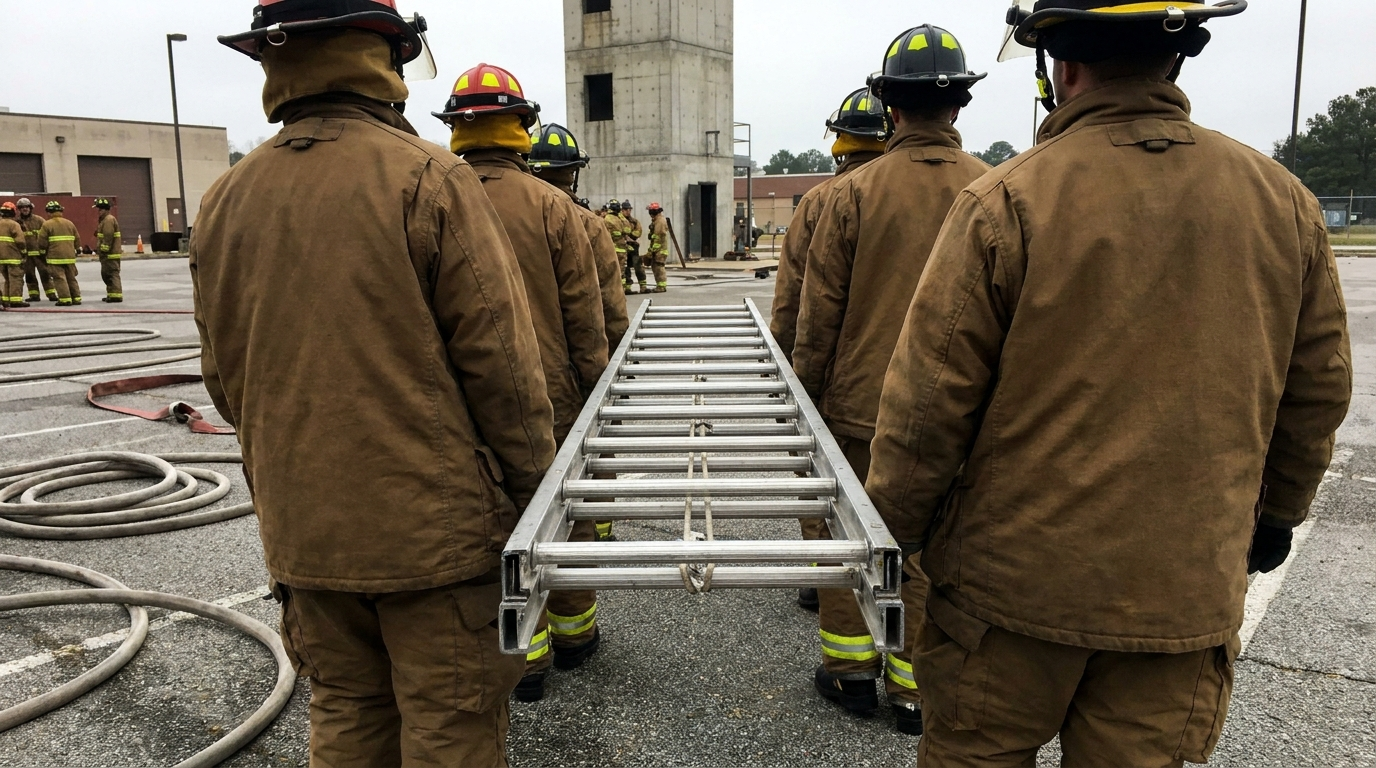
- Manipulative skills. Hands-on drills: hose lays, ladder throws, forcible entry, search and rescue, pulling and advancing lines, self-contained breathing apparatus (SCBA) work. You repeat skills until they are automatic, often in full turnout gear in the heat.
- Academics. Classroom lecture on fire behavior, building construction, hydraulics, EMS, hazardous materials, and department policy.
- Study and clean-up. Gear maintenance, station duties, and then homework at night.
How physically hard is the academy?
Hard enough that people who thought they were in shape get humbled in week one.
You have to arrive already fit. Instructors are not there to build your base fitness from scratch. They assume you can already run, carry weight, and work in gear, and they build from there. Recruits are expected to show up in excellent physical condition on day one, ready for rigorous activity. Most programs require you to have passed a CPAT or Biddle physical test just to get in the door.
The reason the PT is relentless is that the job is relentless. Firefighting is one of the most physically demanding occupations there is, and the academy is where they confirm your body can do it under stress and fatigue. The people who struggle physically are usually the ones who trained for the CPAT, passed it, then stopped training before the academy started. Do not do that. Keep building right up to day one.
A blunt piece of advice: train in gear and train your grip, your legs, and your cardio recovery, not just your bench press. The academy rewards work capacity, the ability to keep going after you are already tired.
How hard is the academic side?
Harder than most people expect, because they came for the physical challenge and forgot there is a classroom.
Many California Firefighter 1 and 2 academies hold a minimum passing standard around 80% on academic work, which is a real bar. You are learning fire behavior, hydraulics, building construction, EMS protocols, hazardous materials awareness, and a large volume of policy and terminology, often on very little sleep. Tests come regularly, and falling below the standard can remove you from the program.
The recruits who do well treat studying as non-negotiable homework every night, quiz each other, and never let a weak subject slide. If reading and test-taking are not your strength, that is exactly the skill to shore up before you start.
What is the discipline and culture like?
Paramilitary. That word matters.
Expect strict standards for uniforms, grooming, punctuality, and conduct. "On time" means early. You will address instructors formally, follow a chain of command, and be held accountable for the whole class when one person falls short. That collective accountability is intentional. The fire service runs on the crew, not the individual, and the academy trains that from day one.
None of this is hazing for its own sake, and good programs make the purpose clear: on a real incident, discipline and attention to detail keep people alive. The recruits who fight the culture, take corrections personally, or think the rules are beneath them are the ones who struggle. The ones who accept correction, fix it fast, and support their classmates get through. Being coachable is not a soft skill here. It is the skill.
Why do recruits get released from the academy?
People do not usually wash out for one dramatic reason. They wash out for one of a few predictable ones:
- Physical standards. Cannot keep up with PT or complete skills within time and safety limits.
- Academic failure. Falling below the passing standard on tests.
- Safety violations. Doing something on the drill ground that would get someone hurt on a real scene. Safety failures are taken very seriously because the stakes are real.
- Attitude and integrity. Not being coachable, cutting corners, or dishonesty. In the fire service, character is not separate from the job.
Notice that most of these are within your control before you ever start. Show up fit, study hard, follow safety rules exactly, and keep your ego in check, and you have removed most of the reasons people fail.
How do you actually make it through?
The recruits who finish tend to do the same handful of things:
- Arrive over-prepared physically. Do not coast after the CPAT. Peak for day one.
- Study every single night. Treat the 80% standard as your floor, not your goal.
- Take corrections without flinching. Fix it, thank the instructor, move on. Do not explain, do not sulk.
- Take care of the small things. Boots, uniform, punctuality, gear ready. The details are the test.
- Support your class. Help the person who is struggling. The crew mentality is being graded even when no one says so.
- Sleep and eat like it is your job. Recovery is part of the work, especially if you are an older recruit.
If you are still working toward the academy, the smartest move is to build the base now: get fit, get your EMT, and understand where the academy sits in the larger hiring process. See how to become a firefighter in California and the firefighter hiring process for the full map.
FAQ
How long is fire academy in California?
It varies by program. Many California academies run roughly 16 to 20 weeks. Some department recruit academies are on the shorter end and some college academies run a full semester or more. Confirm the exact length with your specific program.
Is fire academy paid?
It depends. A department (recruit) academy is usually paid employment, because the department has already hired you. A college fire academy is training you pay tuition for before you are hired. Confirm with the specific program or department. Academy costs vary widely, so run your own numbers in the cost and timeline calculator.
How hard is fire academy?
Hard on purpose. It combines demanding physical training, a heavy academic load with a high passing standard (often around 80%), and strict paramilitary discipline, frequently on limited sleep. It is designed to filter people out. It is very survivable for someone who arrives fit, studies nightly, and takes correction well.
What should I do to prepare for the academy?
Arrive in excellent physical condition, ideally training in gear, and keep building fitness right up to day one. Sharpen your study and test-taking skills. Get comfortable with structure, early mornings, and taking direction. Have your prerequisites (EMT, CPAT) done before you start.
Can you fail out of fire academy?
Yes. Recruits are released for failing physical standards, falling below academic passing standards, safety violations on the drill ground, or attitude and integrity problems. Most of these are within your control with preparation and the right mindset.
Do I need to pass a CPAT before the academy?
Most California academies require you to have passed a CPAT or a department physical test like the Biddle before you begin. Requirements vary by program, so confirm with the one you are entering. See our CPAT guide for how to prepare.
Sources
- South Bay Regional Fire Academy - paramilitary setting, uniform and grooming standards, physical and academic expectations.
- Crafton Hills College Firefighter Academy and Oxnard College Regional Fire Academy - early start times, daily schedule, physical demands.
- Sierra College Firefighter I and II Academy - 80% academic passing standard and CPAT/Biddle requirement.
- Long Beach Fire Academy (Step 8) and San Francisco Fire Recruit Training - academy length examples (16 to 20 weeks) and schedule.
This is an independent resource, not affiliated with CAL FIRE, the FCTC, any college, or any department. Academy structure, length, and standards vary by program and change over time, so verify everything with the specific academy or department. No outcome is guaranteed. Last reviewed: July 2026.