Firefighter Side Business Taxes: What You Can Deduct
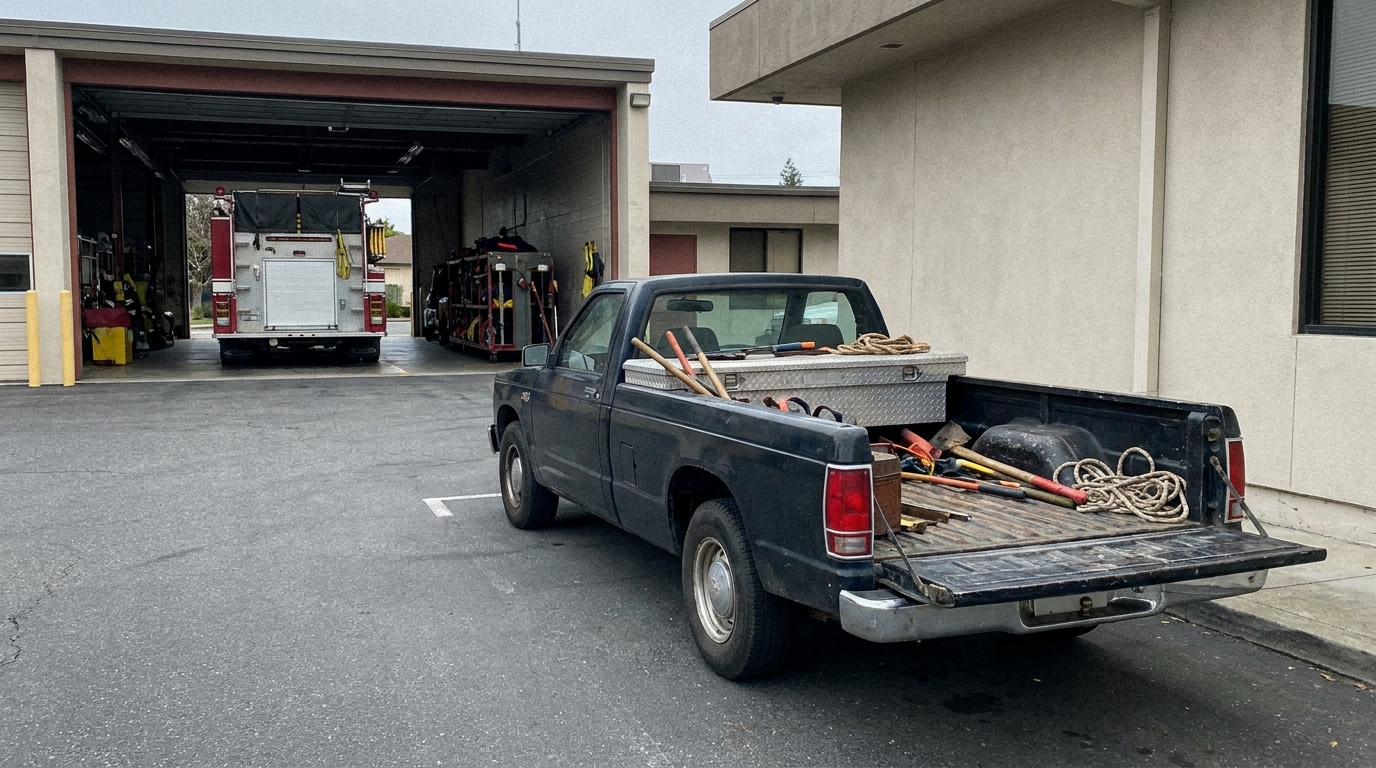
A firefighter side business is taxed like any other sole proprietorship: you report the income and expenses on Schedule C, pay self-employment tax on the profit, and keep records that prove the business is real. The good news most firefighters never hear is that if your W-2 wages are high, the self-employment tax on your side income is far lower than the 15.3% number that scares people off. The bad news is that sloppy record-keeping, unlicensed contracting work, or a "business" that never turns a profit can cost you more than the side gig ever earned.
This is education, not tax, legal, or investment advice. Tax law changes and your situation is specific. Confirm anything here with a licensed CPA or advisor before acting.
Why the 48/96 makes side work almost inevitable
Work a 48/96 and you have four consecutive days off, every cycle, for your whole career. That is why so many firefighters run construction crews, personal training, inspection work, real estate, or a lawn route on the side. The schedule practically invites it. The tax system does not care that you are a firefighter first. The moment you take money for goods or services with the intent to make a profit, you have a business, and the rules below apply whether you ever fill out a form or not.
Schedule C basics
A sole proprietorship (or a single-member LLC, which is taxed the same way by default) reports on Schedule C attached to your Form 1040. Income goes on top, ordinary and necessary business expenses come off, and the net profit flows to your return alongside your W-2 wages. You do not need an LLC to deduct expenses, and forming one does not change your income tax. What you do need, from day one, is a separate account and a record of every dollar in and out. Every fight with the IRS described in this article is won or lost on records.
Net profit also goes on Schedule SE, which is where the most misunderstood number in side-gig taxes lives.
The SE tax surprise: high W-2 earners pay less than they think
Self-employment tax is nominally 15.3% on 92.35% of your net Schedule C profit: 12.4% for Social Security plus 2.9% for Medicare. Here is what the internet calculators skip: the 12.4% Social Security piece only applies up to the annual Social Security wage base, which is $184,500 for 2026 (per IRS Publication 15 for 2026), and your W-2 wages count against that base first on Schedule SE.
Run the math for a firefighter with $170,000 in W-2 wages and a $40,000 side-business profit. Only about the first $14,500 of side earnings faces the 12.4% Social Security piece, because W-2 wages already filled the rest of the base. Everything above the base faces just the 2.9% Medicare tax, plus the 0.9% Additional Medicare Tax once total earned income passes $200,000 single or $250,000 married filing jointly. And half of whatever SE tax you do pay is deductible. So for a big-overtime firefighter whose W-2 already clears the wage base, the real marginal SE cost on side income is often roughly 2.9% to 3.8%, not 15.3%. If a promoter or a firehouse rumor priced your side gig at 15.3% off the top, redo the math before you decide it is not worth it.
The QBI deduction: 20% off qualified profit
The Section 199A qualified business income deduction lets most sole proprietors deduct 20% of their qualified business income, and it is now permanent (made so by the 2025 OBBBA legislation). For 2026, if your taxable income is below $201,750 single or $403,500 married filing jointly (per Rev. Proc. 2025-32), the deduction applies with no wage limits and no service-business restrictions. Above those thresholds it phases toward limits, reaching full limitation at $276,750 single and $553,500 joint. There is also a new floor: at least a $400 deduction if you have $1,000 or more of qualified business income from a business you materially participate in.
For a firefighter grossing under the threshold, this is simple and valuable: a $40,000 side profit can generate roughly an $8,000 deduction. Note the threshold is taxable income, which a heavy overtime year can push past. Your CPA should check where you land.
What you can actually deduct
The ordinary and necessary expenses of the business: tools, supplies, insurance, software, advertising, a fair share of your phone. A few specific ones worth knowing:
- Home office. Real deduction, strict test: the space must be used exclusively and regularly for the business, and it must be your principal place of business (or where you do the admin work with no other fixed location for it), per IRS Topic 509. The corner of the garage where your kids also park bikes does not qualify. The simplified method pays $5 per square foot up to 300 square feet, a $1,500 cap, per the IRS simplified option rules. W-2 firefighters cannot claim a home office for the fire job; this is for the business only.
- Vehicle. The 2026 standard mileage rate changed mid-year: 72.5 cents per business mile for miles driven January 1 through June 30, and 76 cents for miles driven July 1 through December 31, per the IRS standard mileage rate table. Log the date of each trip, because the rate depends on it. That requires a contemporaneous mileage log: date, destination, purpose, miles. No log, no deduction when examined.
- Equipment under $2,500. The de minimis safe harbor lets you expense items up to $2,500 per item or invoice immediately (per the IRS tangible property regulations) instead of depreciating them.
- Startup costs. Up to $5,000 of pre-opening costs deductible in year one under Section 195, reduced dollar for dollar once startup costs pass $50,000, with the rest amortized over 180 months.
The 1099 trap
Two things firefighters get wrong about 1099s. First, the reporting threshold for Form 1099-NEC rises to $2,000 for payments made after December 31, 2025 (per OBBBA Section 70433), so you will receive fewer forms. Second, and this is the trap: your income is taxable whether or not a form ever arrives. "They didn't send me a 1099" is not a tax position, it is an audit finding waiting to happen. Report what you earned, from your own records, every year.
The hobby-loss guillotine
Section 183 says an activity not engaged in for profit gets no business deductions. The safe harbor: show a profit in 3 of 5 consecutive years and you are presumed to be a business (per 26 USC 183). Fail that and the IRS applies a nine-factor facts-and-circumstances test, where businesslike records, a separate bank account, and real effort to become profitable are what save you.
The penalty for losing got permanently worse. Hobby income is fully taxable, but hobby expenses (other than cost of goods sold) are now permanently nondeductible, because the OBBBA made the suspension of miscellaneous itemized deductions permanent. A money-losing "business" reclassified as a hobby means you pay tax on gross receipts while deducting essentially nothing. If your side gig loses money year after year and looks like a lifestyle with a logo, fix that before the IRS characterizes it for you.
California plays by different rules
Your CA return does not mirror your federal return on business write-offs. California allows no bonus depreciation at all, and caps its Section 179 expensing at $25,000, with a phase-out beginning at $200,000 of purchases (per FTB conformity rules). So the truck or equipment you expensed 100% federally gets depreciated over years on the California return. Budget for the difference, and remember California will tax your side profit at your regular CA rates on top of federal.
For what your W-2 fire job itself lets you deduct on the CA return, see what California lets firefighters deduct.
Doing construction work? Know the CSLB line
A large share of firefighter side work is construction, and California draws a hard legal line. Under Business and Professions Code 7048, the handyperson exemption covers only projects under $1,000 total, labor and materials combined, per project, with no job-splitting. Even under $1,000, the exemption applies only if the work requires no building permit and you hire nobody to help. Advertising is a separate trap: Business and Professions Code 7048 removes the exemption from anyone who advertises in a way that suggests they are a contractor, and BPC 7027.2 allows an unlicensed person to advertise only when the job is under $1,000 and the ad says they are not licensed. Anything at $1,000 or more, or any permit-triggering work, requires a CSLB license.
Enforcement is not theoretical. CSLB runs undercover sting operations, and a first offense for unlicensed contracting can bring a fine of up to $5,000 and up to six months in jail. A second offense is worse than most people expect: the court must impose a fine of the greater of $5,000 or 20% of the contract price, plus at least 90 days in county jail unless the court finds the interests of justice call for less (per Business and Professions Code 7028). A misdemeanor is also exactly the kind of thing that complicates a public-safety career. If you are doing real construction work on your off days, get the license or stay strictly inside the exemption.
FAQ
Do I need an LLC for my firefighter side business?
No. An LLC does not change your income taxes (a single-member LLC files the same Schedule C) and is not required to deduct expenses. It can offer liability separation, which matters more for physical work like construction. Whether it is worth the California LLC costs is a question for your CPA and possibly an attorney.
How much self-employment tax will I really pay?
If your W-2 wages already exceed the 2026 Social Security wage base of $184,500 (per the SSA), your side profit faces roughly 2.9% Medicare tax, or about 3.8% above the Additional Medicare thresholds, not the full 15.3%. If your wages are below the base, the 12.4% Social Security piece applies to side earnings until the base is filled. Half of the SE tax is deductible either way.
I did not get a 1099. Do I still report the income?
Yes. All of it. The 1099-NEC threshold is $2,000 for payments made after December 31, 2025 (per OBBBA), so fewer forms will arrive, but taxability never depended on the form. Report from your own records.
What happens if my business loses money every year?
Losses can offset your W-2 income while the activity is genuinely a business. But without a profit in 3 of 5 consecutive years, you lose the Section 183 presumption, and if the IRS reclassifies the activity as a hobby, your income stays taxable while your expenses become permanently nondeductible. Run it like a business or expect it to be treated like a hobby.
Can I deduct my mileage to the fire station?
No. Commuting to your W-2 job is never deductible, and unreimbursed employee expenses are permanently nondeductible federally. The 2026 rate applies to miles driven for your side business, with a log to prove them: 72.5 cents per mile before July 1 and 76 cents per mile from July 1 on.
Sources
- SSA announcement, 2026 Social Security wage base ($184,500), October 24, 2025
- Schedule SE (Form 1040) and IRS self-employment tax rules
- IRS qualified business income deduction pages; Rev. Proc. 2025-32 (2026 QBI thresholds); OBBBA (P.L. 119-21) permanence provisions
- IRS Topic 509 and the simplified home office option ($5/sq ft, 300 sq ft cap)
- IRS standard mileage rates (2026: 72.5 cents through June 30, 76 cents from July 1)
- IRS tangible property regulations (de minimis safe harbor, $2,500)
- 26 USC 195 (startup costs); 26 USC 183 (hobby losses); OBBBA permanent suspension of 2%-floor miscellaneous itemized deductions
- OBBBA Section 70433 (1099-NEC threshold, $2,000 for payments after December 31, 2025)
- FTB conformity rules: no bonus depreciation, $25,000 California Section 179 cap
- Business and Professions Code 7048 (the $1,000 handyperson threshold; amended by AB 1170, Stats. 2025 Ch. 67, effective 1 January 2026, which supersedes AB 2622) and CSLB enforcement bulletins (handyperson exemption, sting operations, penalties)
Keep going
The side business is one piece of the picture. Start with the full guide to how California firefighters actually reduce their taxes and see the money mistakes that catch firefighters early. For the tax-advantaged money you control at work, start with the 457(b). If you want this kind of straight answer in your inbox, join the Golden State Firefighter newsletter.
This is education, not tax, legal, or investment advice. Tax law changes and your situation is specific. Confirm anything here with a licensed CPA or advisor before acting.
Golden State Firefighter is not affiliated with any government agency, department, or retirement system.
Last reviewed: August 2026.